
Maximizing MD-1 In Soccer

Welcome to the latest issue of The Football Scientist.
In this week's issue, I'm going to provide recommendations around how to maximize MD-1 (i.e. day before the match) planning to optimize soccer performance.
I hope you enjoy.
MD-1 Duration
Match day (MD) -1, otherwise known as the day before the match, can be a crucial day within the microcycle planning within soccer.
My own interest in this area stemmed from my PhD research quantifying the load across weekly microcycles in English Premier League players.
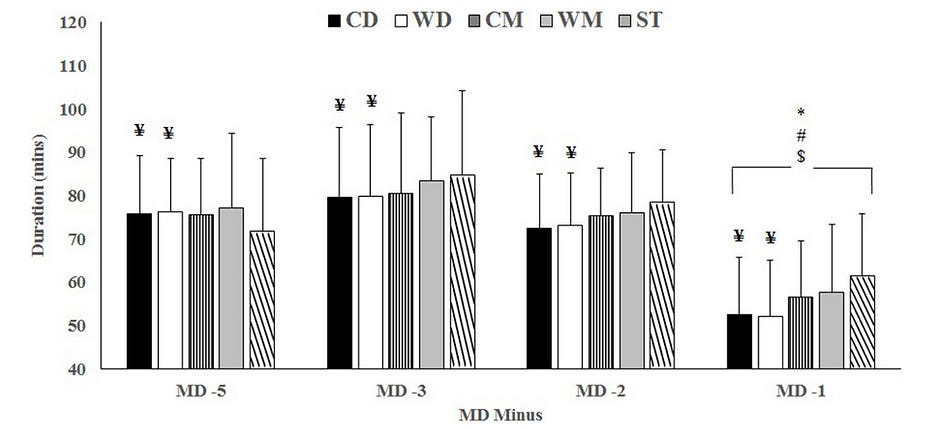
It was clear from the data (and since backed up by other papers) that the overall load on MD-1 is lower in comparison to other days in the microcycle.
Below is an image from a paper I published in IJSPP which shows the differences in duration across a microcycle.
Typical MD-1 sessions were around 50-60 minutes, with some variation depending on whether it was a one or two game week in the schedule (2 game weeks tend to have lower durations).
Recent research from Douchet et al. (2022) found reduced physical preparedness prior to match day when coaches increased MD-1 training duration from 45 to 75 minutes.
Indeed, duration is arguably the easiest way to manipulate load within a training day.
Increasing duration tends to lead to greater physiological and biomechanical loads placed upon players. Keeping MD-1 'short and sharp' makes practical sense.
MD-1 Content
The tactical periodization model, which has become very popular in recent years, describes the MD-1 being a day for training 'sub principles and activation'.
Other people have termed MD-1 as a 'taper' day. It's important to note that reducing training load on only one day isn't strictly a training taper. Indeed, training tapers are typically 2-3 weeks in duration (e.g. in endurance sports, see Inigo Mujika's research in this area). Even then, there are only marginal improvements in physiology in some cases.
I prefer the term 'readiness' or 'freshness' as that is what MD-1 is essentially trying to do.
So, what sort of content should a MD-1 contain.
Obviously we start with the warm up. Following general warm up with dynamic movements, the use of reaction based drills are very useful for MD-1. See link for an example from Liverpool FC. 10-15 mins maximum for this part.
Rondos are also a great way to keep the overall load low whilst also working on players 'readiness' for the match. The rondos should be short in space (6m x 6m) and duration (~10 mins).Every MD-1 should have a tactical walkthrough/set pieces drill. The tactical elements can be presented in a team meeting beforehand, so that the pitch tactical walk through is about emphasizing the key points already discussed.
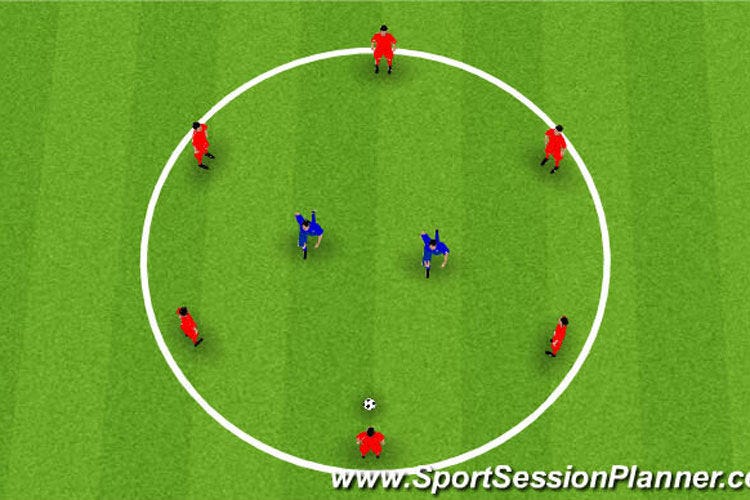
This is a part of MD-1 I've seen been dragged out. Although generally low load (i.e. as players standing around listening to instructions), certain players can experience high load if this type of drill duration is too long.
Typically this might be full backs if a coach is trying to get a certain point across that requires the wide players to make multiple high speed efforts in a large pitch size.
Finally, some coaches like to include a SSG on MD-1 to emphasize the 'sharpness' element prior to a game.
However, I've seen coaches get carried away by these drills. Whether that be long duration (I've seen 30 minutes of SSG is some MD-1 sessions resulting in excessive load), or large spaces (e.g. 10 v 10 full pitch games, not really SSG anyway).
Some use of SSG could be explored (e.g. 4 x 3 min games in small spaces) but this shouldn't be excessive. Indeed, if in a congested fixture period then it would be advised to avoid these altogether to keep the overall load low.
Summary
MD-1 is a crucial day in the microcycle training plan.
Shorter durations (around 45 mins) appear to provide the best stimulus prior to match day.
Keeping drill length short (10-15 mins per drill) helps achieve this target.
Warm ups to include reactive type drills. Make it fun for the players and mix up each week.
Rondos useful for preparedness and again 'fun' element of training.
Tactical walk through and set pieces crucial each MD-1.
Be careful when using SSG drills, too long/intense and players will carry fatigue over into the match.
Thank you for reading, see you next week.
Whenever you're ready, check out how I can help you further:
Football Fitness Mentorship Community: Are you a football fitness practitioner looking to accelerate your career? Join an exclusive online mentorship community of football fitness practitioners and access resources, educational content, 1:1 support and a worldwide network. The community is aimed at football fitness practitioners - whether you are a student with future aspirations to work in football, an early career practitioner still finding their way or experienced practitioners looking to progress their career further. Check it out here.