
Navigating Recovery: Why 72 Hours Might Not be Enough
When a football match ends, the real work for sport scientists begins. While we all know that players need to recover, what's not always clear is just how long that process takes.
A common assumption is that 72 hours is enough, especially with the demanding fixture schedules in professional football. However, recent research suggests that this isn't always the case.
By understanding the true time course of recovery, you can make smarter decisions to keep your team at peak performance and reduce the risk of injury.
Recovery is Not a Straight Line
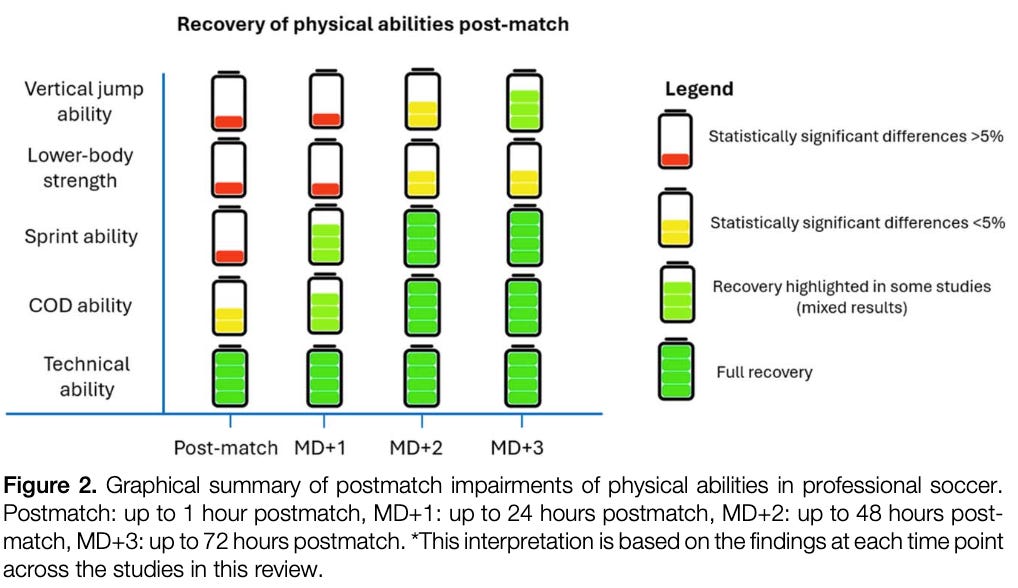
A new systematic review published in the Journal of Strength and Conditioning Research analysed 13 studies to assess the time course of post-match physical impairments in professional soccer players.
The research looked at how different aspects of a player's physical performance, such as sprint ability, vertical jump, and strength, were affected at various points up to 72 hours after a match.
While some performance metrics, like sprint ability and change of direction, tend to recover within 72 hours, other key physical abilities, such as vertical jump and hamstring strength, can still be significantly impaired. This highlights the complex nature of post-match fatigue and shows that not all physical attributes recover at the same rate.
The review also found that recovery profiles vary greatly from player to player. A player's baseline physical fitness, including their strength and aerobic fitness, plays a crucial role in how quickly they return to their baseline performance. Players with higher levels of strength and aerobic fitness tended to recover faster than those with lower fitness levels.
Practical Applications for Coaches
Practitioners should not assume that all players are fully recovered after 72 hours. By paying close attention to individual recovery profiles, especially for metrics related to power and strength, you can ensure your players are truly ready for the next match.
The study highlights that this is particularly important for injury prevention. Implementing a one-size-fits-all recovery strategy without accounting for individual differences or the various timelines of physical recovery can lead to "premature loading," which can increase the risk of injury and lead to performance decreases.
By not assuming all players are fully recovered after 72 hours, you can better manage training loads and minimise the risk of injury.
That's all for today.
See you next Friday.
James
🚀 Join The Football Performance Network
Take your career in football to the next level by joining a global community of 70+ physical performance and sport science practitioners.

As a member, you'll get:
✅ Direct 1:1 mentorship
✅ Live events with industry-leading experts
✅ Practical, high-quality educational content
✅ A supportive network that understands your journey
Whether you're looking to grow your skills, make better decisions in your role, or build your career in elite football, this is the place to do it.
🔗 Join now and start learning, connecting, and progressing together.
📃 Become CASES Accredited
Become CASES Accredited through a structured 6 month cohort programme.

Want to become CASES accredited as a physical performance practitioner in football but feel lost by the process?
Join the accelerated 6 month programme led by Dr James Malone to achieve your CASES accreditation.
🗣 Keynote Speaking
Looking for an enthusiastic keynote speaker with expertise in football science for your next event?

Over the past 15 years I have worked in the Premier League, commercial world supporting elite football teams and leading high-impact football research projects within academia.
My keynote sessions use a blend of the latest scientific evidence coupled with practical knowledge and implementation to make each session impactful for the audience.
Common keynote topics include:
✅ Football periodisation and planning
✅ Recovery strategies in football
✅ Player monitoring and load management
I’m available for both in-person events and online webinars.