
Return to High-Speed Running After Hamstring Injury in Football
Examining the criteria and progression strategies behind return to high-speed running.
Returning a player to high-speed running is not the same as returning them to play.
In many cases, it is the most sensitive and high-risk transition point in the entire rehabilitation process.
High-speed running is the most common mechanism associated with hamstring strain injuries, yet the criteria and progression strategies used to reintroduce it are often based on experience rather than consolidated evidence.
A recent scoping review by Perna et al. (2026) set out to examine exactly what criteria are being used to progress soccer players back to high-speed running after a hamstring injury, and how that exposure is managed on-field.
Only eight studies met the inclusion criteria. That alone highlights how limited the applied evidence base currently is in this specific phase of rehabilitation.
Pain Resolution Is the First Gateway
The most common criterion reported was the absence of pain.
This typically included pain-free clinical assessment, pain-free strength testing, and pain-free low to moderate speed running drills. Some protocols also required pain-free single-leg squats or cycling before progressing.
Clinically, this makes sense. Pain reflects tissue irritability.
However, pain-free does not automatically mean sprint-ready. The mechanical demands of maximal velocity running are significantly greater than those seen in controlled gym or submaximal field tasks.
Pain resolution may be the entry point, but it should not be the only decision-maker.
Strength Restoration Before Speed Exposure
Strength restoration should not be an afterthought before reintroducing high-speed running. It is one of the few objective anchors we have in an otherwise grey decision-making space.
In the review, several studies incorporated hamstring strength testing prior to progression, most commonly using isometric posterior chain assessments with a target of less than 10% inter-limb asymmetry.
Peak force was typically measured, and in some cases rate of force development was also considered. The intention is clear. Before exposing tissue to the high forces of sprinting, there should be evidence that force production capacity has been restored.
However, the commonly cited 10% asymmetry rule should be viewed as guidance rather than a rigid pass or fail threshold. Asymmetry is task-specific and influenced by testing position, device, and athlete profile.
A single number rarely captures the full neuromuscular picture.
The bigger principle is this - if you are about to reintroduce maximal velocity running, you need objective data showing that the hamstring can tolerate high force output again. Strength testing does not eliminate risk, but it reduces uncertainty.
In many cases, it may be the difference between a calculated progression and an educated guess.
Imaging Can Support Decisions
In tendon-related injuries, MRI or ultrasound findings were used in some case studies to inform progression to higher speeds.
MRI and ultrasound were utilised to assess factors such as resolution of oedema, changes in tendon signal intensity, and signs of tissue healing before progressing athletes beyond approximately 85% of their maximum speed.
In these cases, imaging formed part of the decision-making framework, particularly where intratendinous involvement was present and clinical presentation alone may not have captured the full picture.
However, imaging should support the decision, not dictate it. Structural healing does not always align neatly with functional readiness.
Players can present with residual signal changes yet demonstrate excellent strength, mechanics, and tolerance to progressive loading.
Conversely, a reassuring scan does not guarantee that neuromuscular capacity has been restored.
Imaging is most valuable as a risk management tool within the broader clinical conversation, especially in complex or higher grade injuries. It should sit alongside pain status, objective strength data, and on-field progression rather than replace them.
Progression Must Be Structured
Clearing a player for high-speed running is only one checkpoint. The real challenge lies in how that exposure is built over time.
The review highlighted two primary approaches to managing this phase of rehabilitation.
One was the control-chaos continuum, which gradually progresses athletes from highly controlled, linear running drills towards increasingly unpredictable, reactive, and match-like scenarios.
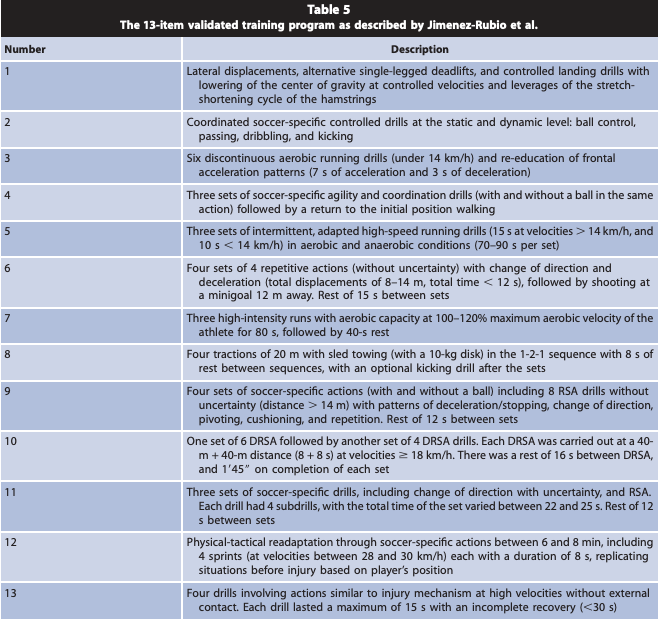
The other was a validated 13-item on-field programme that integrates acceleration, deceleration, repeated sprint ability, and soccer-specific movements in a staged format.
Both approaches reinforce the same principle. High-speed running must be progressively reintroduced, not simply ticked off.
Weekly high-speed distance, peak velocity exposure, and drill complexity should be carefully staged and aligned with the player’s positional and match demands.
Abrupt spikes in speed volume, or premature integration into chaotic team drills, are likely points where tissue capacity is exceeded.
Structured progression reduces that risk by ensuring the mechanical and contextual demands of match play are rebuilt systematically rather than assumed.
Key Take Home Points
Return to high-speed running is a critical phase, not a minor checkpoint.
It carries substantial mechanical load and should be treated as a defined step within the rehabilitation pathway.
Pain-free status is essential, but not enough on its own. Clearance for sprinting should be supported by objective strength data that demonstrates restored force capacity, not just symptom resolution.
Imaging can support decision-making, particularly in tendon-related injuries, but it should complement, not replace, clinical and functional assessment.
Most importantly, high-speed running exposure must be progressive. Build speed, volume, and drill complexity in a staged manner. Avoid sudden spikes and premature exposure to chaotic match-like demands.
A question for you: What criteria do you currently rely on before exposing a player to high-speed running, and how confident are you in that decision?
Leave a comment and tell me. I read every response.
Another excellent article!
It’s quite interesting that only eight studies in the review of research were included. As you stated, a sign of the varied approaches to return to high speed running.
We definitely use the pain or absence of it for making decisions on starting a return to high speed running.
I think we struggle with not having a clear progression in mind from there. Generally we follow a system of one non contact day, into a contact training day with reduced volumes, and then a full training session.
Some structural issues we’re facing as a club are definitely getting in the way of a more robust return to running program. Growing pains of a new club for sure.
Thanks for sharing this article!
This is a lovely example of taking an academic source, i.e the scoping review, and translating it into good, clear practical advice for practitioners.