
Return to Play Doesn't Mean Return to Normal
Why injury risk remains elevated after muscle injuries in football
One of the biggest misconceptions in football is that injury risk returns to normal once a player is medically cleared to return to play.
In reality, returning to training is simply the start of another high-risk period. While practitioners often recognise that players are vulnerable in the early stages after rehabilitation, we rarely consider whether that risk changes depending on the type of injury they sustained.
A new study from Zhang et al. (2026) analysing 678 hamstring, quadriceps, adductor and calf injuries across three seasons of the German Bundesliga examined exactly that. Rather than reporting a single injury rate, the researchers mapped how non-contact subsequent injury risk changes over time after return to play, revealing that every muscle injury follows its own unique risk trajectory.
Injury risk is not constant after return to play
Most injury studies report average injury rates across several weeks or months after return to play. While useful, this approach assumes injury risk remains relatively stable throughout that period.
This study challenges that assumption.
Using time-to-event analysis, the authors demonstrated that subsequent injury risk changes continuously throughout rehabilitation and reconditioning. For most muscle injuries, risk is highest immediately after return to play before gradually declining. However, the timing and rate of this decline differs considerably between muscle groups.
This suggests practitioners should stop thinking about return to play as a single event and instead view it as an extended period of progressive risk management.
Different muscle injuries require different management strategies
One of the most interesting findings was that each muscle group displayed a distinct recovery profile.
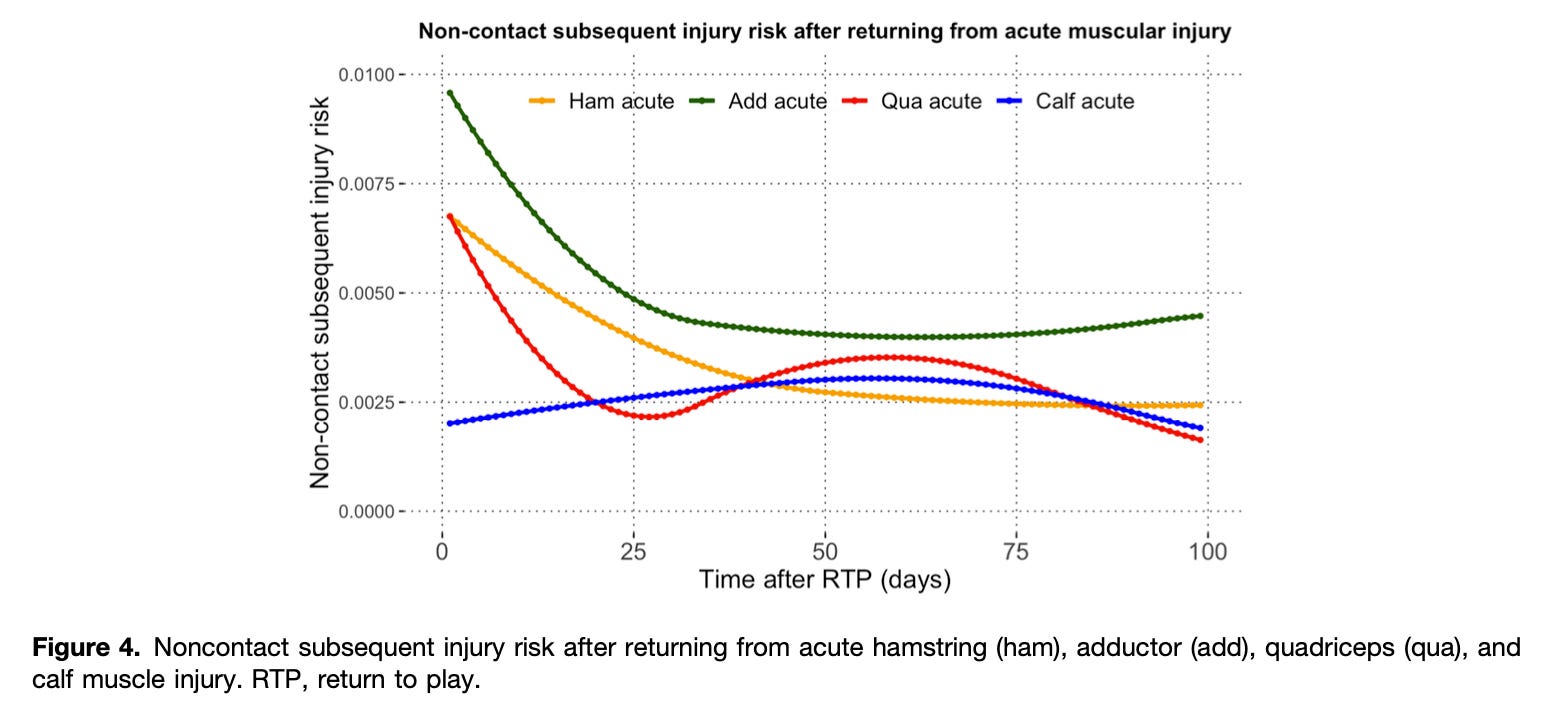
Players returning from acute hamstring injuries demonstrated an elevated injury risk that gradually reduced over approximately 50 days before stabilising. Acute adductor injuries showed an even higher initial risk, but this declined rapidly during the first four weeks. Acute quadriceps injuries followed a similar pattern, with a sharp reduction during the first month before a small secondary rise later in the recovery period.
Acute calf injuries, however, behaved differently. Rather than showing a pronounced early spike, injury risk remained relatively low and stable throughout the post-return period.
These findings reinforce that rehabilitation timelines should not simply be based on tissue healing. The monitoring and progression strategy following return to play should also reflect the specific injury diagnosis.
Overuse injuries follow a different recovery pattern
Perhaps the most clinically relevant finding was the behaviour of overuse injuries.
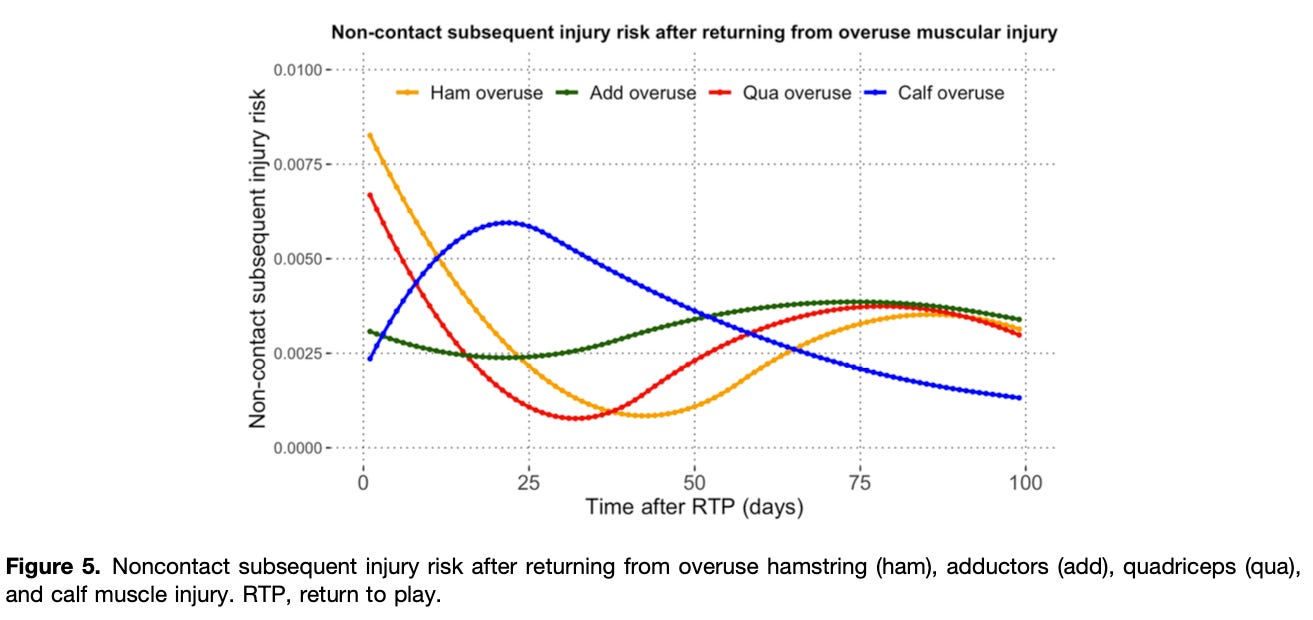
Unlike acute injuries, several overuse injuries did not demonstrate their highest injury risk immediately after return to play.
Overuse calf injuries, for example, showed a delayed peak approximately three weeks after returning to full training before gradually declining. Overuse hamstring and quadriceps injuries displayed greater variability, with injury risk falling initially before increasing again later during the return period.
This highlights a common challenge in practice. If players successfully complete their first week or two back in training, there can be a temptation to assume the rehabilitation process has been completed.
For some overuse injuries, however, the highest-risk period may actually occur after that initial reintegration phase, emphasising the importance of continued monitoring beyond the first few sessions.
Return to play should become return to performance
These findings support a shift in how practitioners think about rehabilitation.
Medical clearance should not signal the end of injury management. Instead, it should mark the beginning of a structured return-to-performance phase where practitioners progressively expose players to increasing physical, technical and tactical demands while recognising that injury risk evolves over time.
Rather than applying identical monitoring periods to every muscle injury, practitioners may benefit from individualising their post-return strategies according to injury type, expected risk trajectory and training exposure.
Ultimately, rehabilitation does not finish when a player returns to training. It finishes when they can consistently tolerate the demands of football without elevated injury risk.
Final Thoughts
This study reminds us that return to play is not a finish line.
Subsequent injury risk is dynamic, varies between muscle groups, and extends well beyond the day a player returns to full training.
The most effective practitioners are unlikely to be those who simply get players back quickly. They will be those who understand how injury risk evolves over the following weeks, and adapt their monitoring, loading and progression strategies accordingly.
That’s all for today.
See you next Friday.
James
🚀 Join the Waitlist for The Football Performance Network
If you’re serious about growing your career in football, join a global community of 90+ physical performance and sport science practitioners inside the Football Performance Network.

As a member, you’ll get:
✅ Direct 1:1 career support and community feedback
✅ Live events with elite-level experts
✅ Practical, research-informed learning you can use immediately
✅ A supportive network that understands your journey
⚽️ Our doors open again in 2027.
🔗 Join the waitlist today to be first in line when applications open.