
Understanding Training Effects in Football
A shift from short term monitoring to long term player adaptation.
Most monitoring systems in football are built around a simple question.
Is the player ready today?
It makes sense. You want to know who to push, who to hold back, and how to plan the session. But the problem is that this question only gives you a very small part of the picture.
A recent framework paper by Rebelo and colleagues suggests we may be focusing on the wrong thing.
Performance is not built on how a player feels today. It is built on how they have adapted over time.
Monitoring Alone Does Not Improve Performance
Monitoring has become deeply embedded in modern football environments, with practitioners now having access to large amounts of data from GPS, internal load measures, neuromuscular tests, and subjective wellness scores, all of which can create the impression that more data will naturally lead to better outcomes.
However, it is important to recognise that monitoring itself does not improve performance, it simply provides information that can support decision making.
The real value lies in how that information is used, as collecting high quality data without translating it into meaningful changes in training design or player management ultimately adds very little.
If your monitoring system is not actively influencing what you do on the pitch or in the gym, then it becomes more of a reporting tool than a performance tool, and this is where many systems lose their effectiveness in applied settings.
The Problem With Readiness
Readiness scores are appealing because they simplify complex information into a single value, making them easy to interpret and communicate within multidisciplinary teams, but this simplicity also creates limitations that can influence decision making in the wrong direction.
Readiness is inherently short term in nature, as it reflects how a player is responding at a specific moment in time, rather than providing insight into how they are adapting across a training block or competitive period.
A player may present as fatigued on a given day but still be progressing exactly as planned within a well structured programme, while another player may appear ready on paper despite being underloaded or lacking sufficient stimulus to drive improvement.
When practitioners rely too heavily on daily readiness scores, there is a risk of becoming overly reactive, managing individual days in isolation rather than understanding the broader training process and its intended outcomes.
Fatigue Is Not Always a Problem
One of the key conceptual shifts highlighted in this framework is the need to reframe how we view fatigue within the training process, as fatigue is often treated as something negative that should be minimised wherever possible.
In reality, fatigue is a natural and necessary consequence of training stimulus, and without it there is little opportunity for adaptation to occur.
The important consideration is not whether a player is fatigued, but whether that fatigue is appropriate given the context of the training week, the phase of the season, and the individual player’s profile.
For example, higher levels of fatigue may be expected and even desirable during certain loading phases, whereas similar levels at other times may indicate a mismatch between load and recovery.
This shift in thinking moves practitioners away from simply trying to reduce fatigue, towards understanding its role within the overall adaptation process.
Trends Over Time Matter More
Daily monitoring data can often be noisy and influenced by a wide range of external factors such as travel, sleep, psychological stress, and match exposure, which means that interpreting single data points in isolation can be misleading.
What provides greater value is the ability to identify trends over time, allowing practitioners to assess whether a player is improving, maintaining their current level, or gradually declining in response to training.
By taking a longer term view, it becomes easier to understand individual responses to load and to make more informed decisions about progression, maintenance, or reduction of training stimulus.
This approach shifts the focus from reacting to short term fluctuations towards actively managing the direction of a player’s development, which is ultimately the goal of any performance programme.
Keep It Simple and Individual
Another important takeaway from this framework is that more complex monitoring systems are not necessarily more effective, and in many cases they can create unnecessary noise and confusion within the decision making process.
Practitioners often attempt to track a large number of variables and apply group based thresholds, but this can reduce clarity and make it harder to identify meaningful insights.
Simpler systems that focus on key metrics and prioritise individual responses tend to be more practical and impactful, as they allow practitioners to build a clearer understanding of how each player reacts to different types and volumes of training load.
Individualisation is critical, as players with similar external loads may respond very differently internally, and recognising these differences is essential for effective planning and progression.
Key Take Home Points
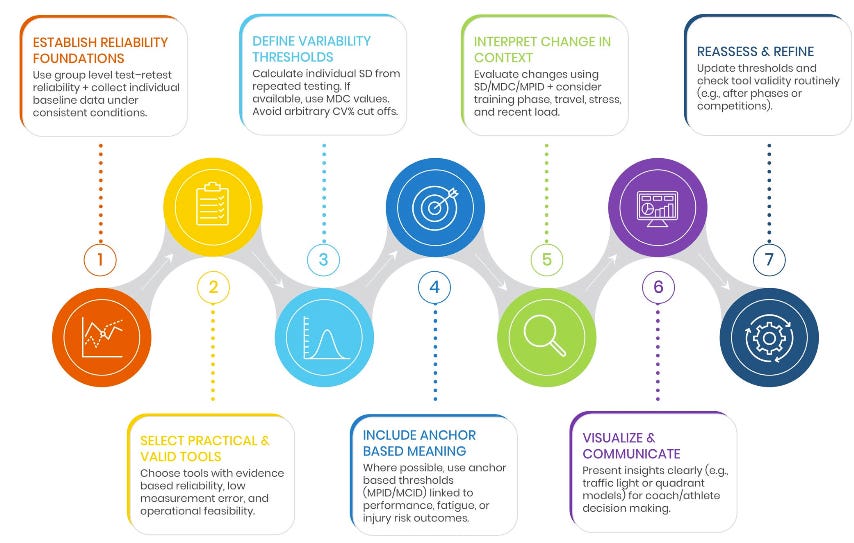
The key shift proposed by this framework is not a complete rejection of readiness monitoring, but rather a repositioning of its role within a broader system that prioritises understanding training effects over time.
Practitioners should move beyond focusing solely on whether a player is ready on a given day, and instead aim to understand how that player is adapting across weeks and months of training and competition.
By placing greater emphasis on longitudinal trends, individual responses, and the context in which fatigue occurs, monitoring can become a more powerful tool for guiding decision making.
Ultimately, performance is not determined by short term readiness, but by the accumulation of appropriate training stimuli and the adaptations that follow.
Football Performance Network
If you want to make better decisions around training, load, and player development, this is exactly what we work on inside the Football Performance Network.
You will be learning alongside 70+ physical performance coaches and sport scientists working in professional football, sharing ideas, solving problems, and improving your day to day practice.
The next intake opens in July.