
When Should We Programme Gym Work Within a Football Microcycle?
What really dictates when we lift.
Deciding when to place gym sessions within a football microcycle is one of the most debated topics in applied performance practice.
On paper, the logic seems straightforward. Matches create fatigue, recovery follows, and gym work is fitted into whatever space remains. In reality, the interaction between football load, neuromuscular fatigue, recovery timelines, and fixture congestion makes this decision far more complex.
The question is not simply when can we lift, but when can we lift with enough quality to actually maintain or develop physical qualities without compromising football performance.
This is where many in-season gym programmes quietly drift into maintenance or underloading, often without practitioners realising it.
The Common In-Season Approaches
Across professional football, we tend to see a small number of recurring patterns when gym work is programmed during the season.
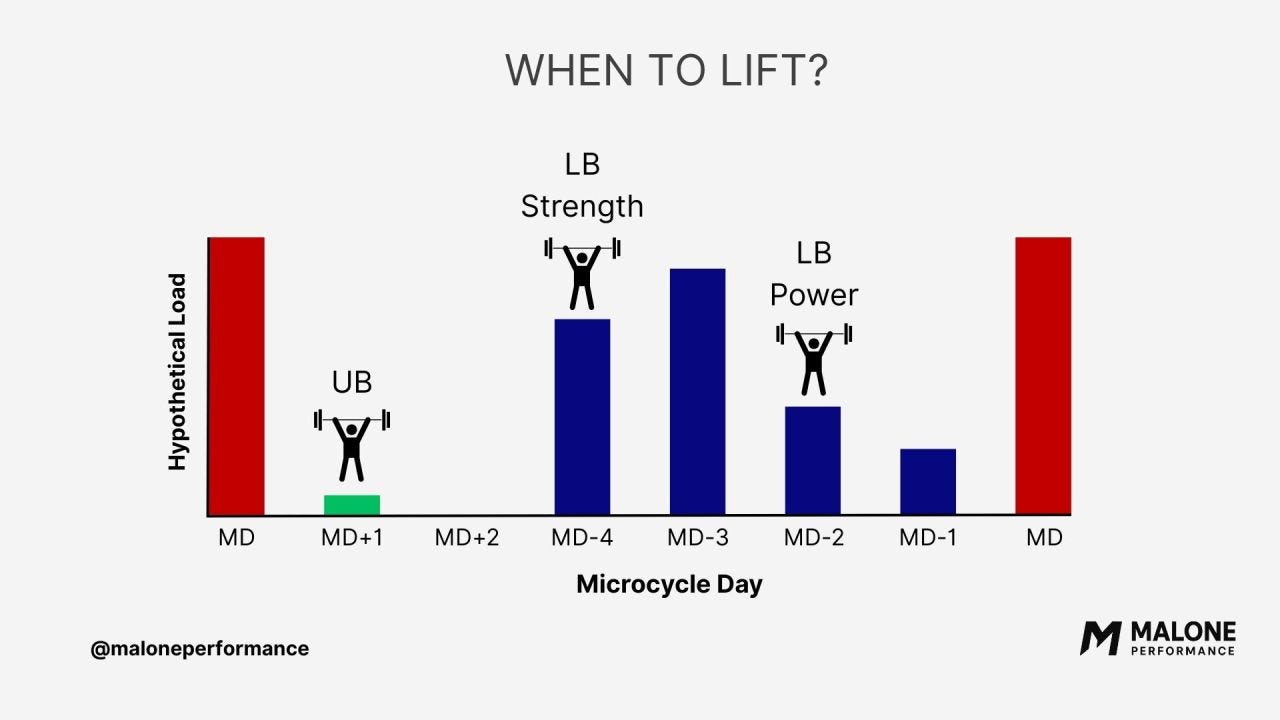
Upper body sessions are often placed on MD+1. The rationale is sensible. The lower body is still dealing with match-induced fatigue, while upper body work allows some exposure to resistance training without adding further stress to the legs.
Lower body strength work is commonly placed on intensive pitch days, often around MD-4 or MD-3 in a seven-day cycle. These days already carry higher mechanical and metabolic loads, so the gym session is aligned with the hardest football stimulus of the week.
Lower body power work is frequently placed on MD-2, usually at low volume and high intent. This fits with the idea of potentiation rather than development, with the goal being to sharpen neuromuscular output without creating residual fatigue before match day.
These approaches are logical, widely used, and often necessary when squad sizes are small and fixtures are dense.
However, logic does not always translate to meaningful adaptation.
The Strength and Power Development Dilemma
A recurring criticism from experienced practitioners is that many in-season gym programmes no longer create sufficient stimulus to develop strength or power.
Microdosing is often presented as the solution. Smaller doses, applied more frequently, should allow qualities to be maintained without interfering with football. In practice, microdosing can easily become underloading, particularly when players arrive fatigued, time is limited, and intent drops.
There is also a sequencing issue. Heavy lower body lifting on MD-4 followed by a demanding pitch session on MD-3 can create problems, especially if pitch work involves high-speed running, accelerations, or extensive tactical volume. The theoretical separation between gym and pitch load often disappears in real environments.
The concern is not whether gym sessions exist, but whether they are capable of producing meaningful stimulus under real-world constraints.
This is an uncomfortable but necessary reflection for performance staff.
Individualisation Over Fixed Rules
One of the strongest themes across modern practice is the move away from fixed team rules and towards individualised exposure.
Not all players experience the microcycle in the same way. Match minutes, positional demands, injury history, and physical profile all influence readiness to train.
For some players, MD+2 may be the most appropriate window for lower body strength work, especially if match minutes were low. For others, MD-2 microdosed power work may be the only viable option during congested periods.
Force velocity profiling, wellness data, match exposure, and recent training history all provide valuable context. Used well, they allow practitioners to shift from asking when do we lift, to who should lift, what should they lift, and how much is enough today.
This approach demands more planning and more communication, but it also respects the reality that one microcycle does not fit all players.
The Role of Intent and Quality
Perhaps the most overlooked factor in in-season gym programming is intent.
Short sessions are not inherently ineffective. Low volume does not automatically mean low stimulus. What matters is whether players are moving loads with genuine intent, appropriate velocities, and sufficient mechanical demand.
A five-rep strength set performed with focus and intent can be more valuable than a longer session completed under fatigue and time pressure. The same applies to power work. Jumps, Olympic lifts, and ballistic exercises only serve their purpose if velocity and intent are preserved.
This places a premium on session clarity. Players need to understand why the session exists and what it is targeting. Without that clarity, gym work quickly becomes another box to tick in a crowded week.
Bringing it Together in Practice
There is no universally correct answer to when gym work should sit within a football microcycle.
What is clear is that rigid rules rarely survive contact with fixture congestion, travel, and squad availability. Effective programmes are flexible, individualised, and honest about what can realistically be achieved in-season.
The goal is not to force strength and power development into unsuitable windows, but to identify where quality exposure can occur without undermining football performance.
Sometimes that means accepting true maintenance. Other times it means being brave enough to load when the opportunity genuinely exists.
Key Take Home Points
Gym work placement should be driven by quality, not tradition.
Microdosing can be effective, but only if stimulus and intent are preserved.
Individual match exposure and readiness should dictate gym decisions more than fixed team rules.
Lower body lifting and pitch load sequencing needs careful coordination to avoid compounding fatigue.
In-season gym work is less about perfect timing and more about making the best possible decision within imperfect conditions.
As always, the most valuable answers tend to emerge not from models or diagrams, but from honest reflection on what is actually happening on the gym floor and on the pitch.
A question for you: Where in the weekly microcycle do you feel gym work is most compromised in your environment, and why?
Scroll down and add a short comment below. Even one sentence is useful and helps shape future articles.
Thanks for reading, see you next Friday.
James
Very good.
James, James, when you can, take a look at my post, hanks:
https://www.linkedin.com/posts/clebersgarbitreinadorgoleiros_o-que-acontece-em-cada-dia-do-microciclo-activity-7397650026254024704-XYDk?utm_source=share&utm_medium=member_android&rcm=ACoAAEBEngEBmUvNo1CuOkFnIktSAazjJ53rtaM