
Why Menstrual Cycle Predictions Are Less Accurate Than You Think
And what that means for your monitoring and decision-making
Menstrual cycle tracking is becoming more embedded in elite football environments.
With more practitioners using AMS platforms and apps to predict cycle phases, ovulation, and next bleed, there is a growing assumption that these tools provide useful precision for planning.
But a new applied study from Casey Greenwalt and colleagues challenges that idea.
This research followed professional female players across an entire season and tested how accurate commonly used prediction equations actually are in practice.
The results suggest we may need to rethink how much we rely on these predictions.
All Equations Perform Similarly, and None Are Highly Accurate
One of the most striking findings from the study is that no equation clearly outperformed the others.
Across five commonly used models, prediction error for next bleed was consistently around six days, with moderate reliability but high variability between cycles .
For ovulation, the picture was similar.
Even the “best” equation still showed meaningful error, and overall reliability remained only moderate.
In simple terms, whichever equation you use, you are working with a fairly wide margin of error.
Cycle Variability Is the Real Problem
The biggest issue is not the equations themselves.
It is the biology.
Menstrual cycles are inherently variable, even within the same athlete. Previous research shows that very few individuals have identical cycle lengths across consecutive cycles, and fluctuations of several days are common .
This study reinforces that.
Prediction error increased as cycle length increased, meaning longer or more irregular cycles were harder to predict accurately.
This is a key point for practice.
The more variability you have, the less confidence you should place in predicted dates.
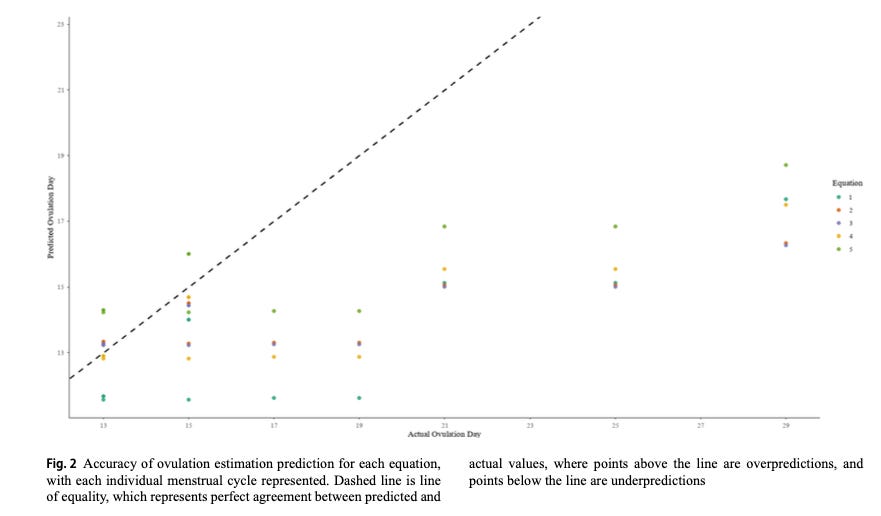
We Tend to Predict Ovulation Too Early
Another consistent finding was that predicted ovulation tended to occur earlier than the actual ovulation window.
Across equations, prediction error ranged around 3–5 days, with systematic bias towards earlier estimates .
This matters.
If practitioners are aligning training decisions, symptom expectations, or conversations around predicted ovulation, there is a risk that timing is off.
And in applied environments, even small timing errors can influence how useful that information really is.
Monitoring Still Matters More Than Predicting
Despite the limitations of prediction models, this does not mean menstrual cycle tracking has no value.
Far from it.
The study highlights that tracking cycle characteristics over time, alongside symptoms, still provides meaningful insight for practitioners.
What changes is how we interpret predictions.
These models should be viewed as general guides, not precise tools.
The most effective approach is likely combining:
Ongoing cycle tracking
Athlete feedback
Simple objective measures, where possible
Rather than relying purely on predicted dates.
What This Means for Practice
If you are using menstrual cycle predictions in your environment, the key shift is this:
Move from precision thinking to probability thinking.
Instead of asking:
“Exactly when will this athlete ovulate?”
A better question might be:
“What is the likely window, and how confident am I in that estimate?”
This is particularly important for athletes with longer or more variable cycles, where prediction error is highest.
In these cases, predictions should be treated with even greater caution.
Final Thoughts
Menstrual cycle prediction is useful, but limited.
No equation is clearly superior, and all come with meaningful error.
Cycle variability is the main challenge, not the model itself.
Ovulation is often predicted earlier than it actually occurs.
Monitoring trends and athlete feedback is more valuable than relying on predicted dates alone.
Here’s a question for you:
How are you currently using menstrual cycle data in your environment, and how confident are you in the decisions you’re making from it?
If you’re comfortable sharing, reply and tell me. I read every response and always try to reply where I can, I really enjoy hearing how this is being applied in different environments.
That’s all for this week.
See you next Saturday.
Football Performance Network
If this paper highlights anything, it’s that more data doesn’t always mean more precision, it’s how you interpret and apply it that matters.
That’s exactly what we focus on inside the Football Performance Network.
How to take research like this, understand the limitations, and turn it into better decisions around training, load, and player development.
You will be learning alongside 70+ physical performance coaches and sport scientists working in professional football, sharing ideas, solving problems, and improving your day to day practice.
The next intake opens in July 2026.